
Vision
VOLTS envisions a future where formerly incarcerated Black women in Chicago can return to a village of care that affirms their belonging, meets their economic needs, and builds collective power to transform the systems that limit their self-determination.
Purpose
VOLTS builds economic power and self-determination by incubating worker and housing cooperatives owned and governed by formerly incarcerated Black women and other systems impacted people. Through cooperative education, infrastructure, and community-led leadership, we create pathways to ownership, wellness, and collective liberation.
Values
Liberation: Reclaiming control over labor, land, and governance.
Trust & Accountability: Practicing transparency and mutual responsibility.
Care & Healing: Valuing rest, joy, and each other’s wholeness.
Popular Education & Leadership: Everyone is a learner and a leader.
Flexibility & Innovation: Learning from the work and changing with it.
VOLTS HISTORY
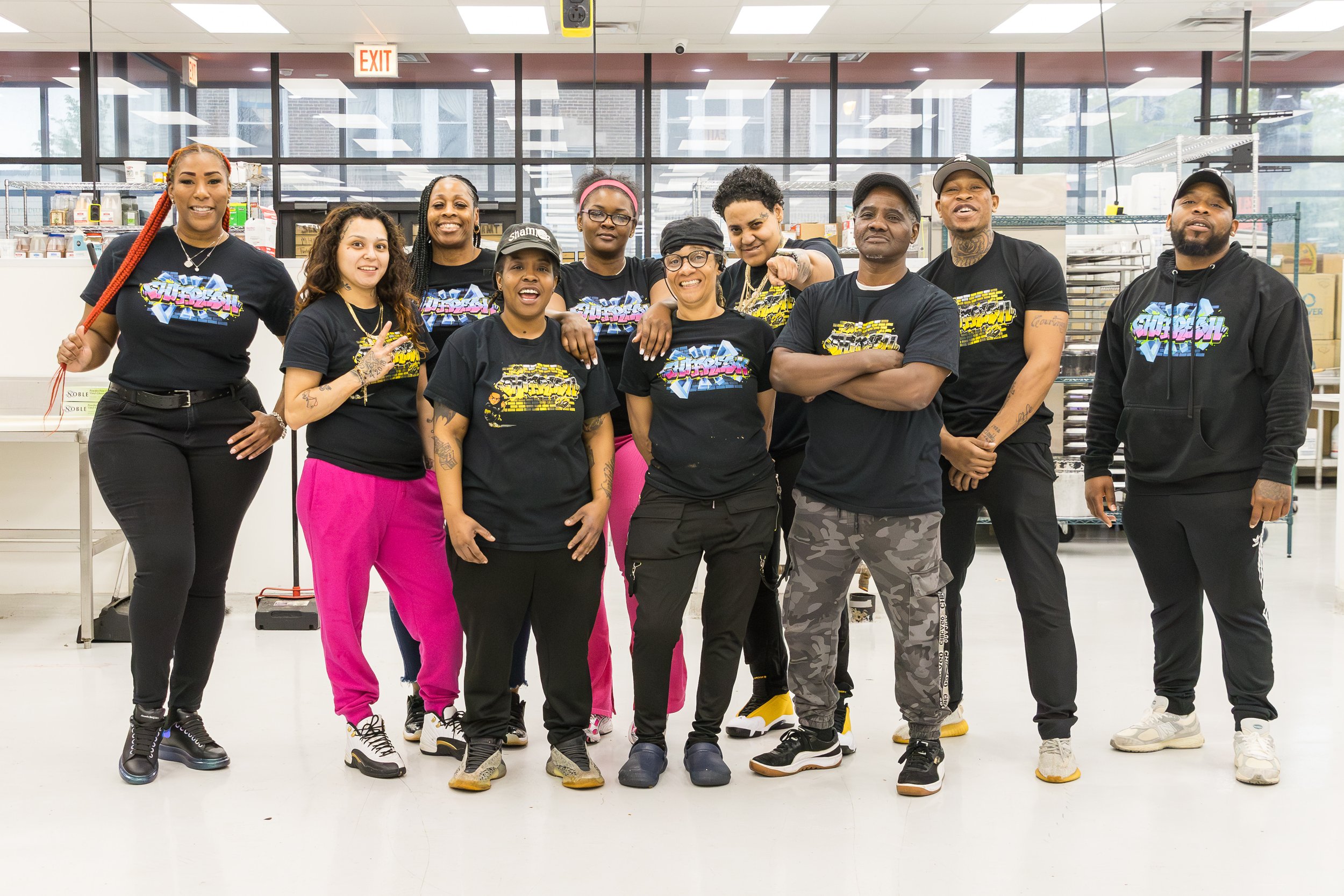
The roots of VOLTS trace back to 2018, when Camille Kerr of Upside Down Consulting and Joan Fadayiro, a local organizer, began developing ChiFresh Kitchen in partnership with an advisory board of formerly incarcerated women.
In December 2019, the team hosted ChiFresh’s first kick-off meeting, where five formerly incarcerated people committed to becoming the founding worker-owners. Advisory board member Colette Payne recruited Kimberly Britt from Grace House, a transitional home where she was living. Kim brought three of her friends—Edrinna Bryant, Renee Taylor, and another friend —and a fifth member joined through his sister, who also lived at Grace House. Together, the original five began meeting weekly to design the business and shape their cooperative vision.
When the pandemic hit in early 2020, the members chose to accelerate their launch to meet urgent income needs—moving into a shared kitchen in April and serving their first meals in May, powered by a community crowdfunding campaign. In the midst of the pandemic, ChiFresh gained critical support from partners like Urban Growers Collective and the Chicago Food Policy Action Council, who connected them with major emergency meal contracts. Early philanthropic partners—including Capital Impact Partners, the American Heart Association, Chicago Beyond, and the Catholic Campaign for Human Development—helped build the infrastructure and provide training that sustained the co-op’s early growth.
By the end of 2020, ChiFresh had purchased a building to develop into its own commercial kitchen—a major step toward stability and ownership. In March of 2021, the co-op grew its revenue through its first major institutional contract while managing a $2M real estate development project, supported by The Chicago Community Trust’s We Rise Together Fund, its Pre-Development Fund, the Neighborhood Opportunity Fund, the Builder’s Initiative, the Margot and Thomas Pritzker Family Foundation, and the American Heart Association.
In October of 2022, ChiFresh moved into its new headquarters. Later that year, ChiFresh Kitchen, Upside Down Consulting, Urban Growers Collective, Women’s Justice Institute, and Grow Greater Englewood were awarded a JPMorgan Chase AdvancingCities grant to build new cooperatives and expand their impact—providing the first funding for what would become VOLTS.
In 2023, members’ vision for stable and affordable housing became reality with the launch of Jumpstart Housing Cooperative, which purchased its first three-flat in Bronzeville that September. By early 2024, VOLTS supported the launch of CrossTreats, a new food manufacturing cooperative, and ChiFresh reached a milestone—becoming a $2 million company.
VOLTS was officially registered as a nonprofit in November 2024 with its founding board, composed of members of ChiFresh Kitchen, Jumpstart Housing Cooperative, and Upside Down Consulting: Amanda Sarria, Camille Kerr, Edrinna Bryant, Kimberly Britt, Mike Tekh Strode, Nyah Griffin, Peter Frank, and Renee Taylor. VOLTS received its 501(c)(3) determination letter in May 2025. Soon after, we launched training for our newest cooperative, The Handlers Cooperative, a worker-owned property management business.
Today, the VOLTS ecosystem includes three worker cooperatives and one housing cooperative with two residential buildings—and we’re developing a Community Investment Vehicle for a new property that will become a community market and “Everything Library.” From ChiFresh’s humble beginnings in a shared kitchen to this growing network of cooperative enterprises, VOLTS continues to build the infrastructure for a new kind of economy—one rooted in ownership, dignity, and community power.
FAQ
-
How is VOLTS related to ChiFresh Kitchen?
VOLTS grew directly out of the success of ChiFresh Kitchen.
ChiFresh showed what’s possible when formerly incarcerated Black women own the institutions that shape their lives—creating stability, dignity, and community wealth. That success revealed the need for a dedicated organization to replicate and expand this model across Chicago.
In 2023, ChiFresh and its partners won a transformative JPMC Advancing Cities grant to build that wider cooperative infrastructure. VOLTS is that infrastructure.
Today, VOLTS incubates new worker and housing cooperatives and provides the shared systems—business support, operations, financing, and organizational backbone—that help them take root and thrive. VOLTS also continues to support ChiFresh’s growth and governance as part of this expanding cooperative ecosystem.
-
What is a cooperative?
A cooperative, or co-op, is a business or organization that’s owned and governed by the people who use it—whether they’re workers, residents, or community members. Instead of maximizing profit for outside investors, co-ops prioritize meeting the shared needs of their members and community.
At VOLTS, we focus on worker cooperatives and housing cooperatives. Worker cooperatives are businesses owned and managed by the workers themselves, who share in profits and decisions about how the business operates. Housing cooperatives are collectively owned homes where residents share responsibility and decision-making, ensuring stable, affordable housing without relying on absentee landlords.
These models build community ownership, stability, and economic power for formerly incarcerated women and their families.
-
How many co-ops are in the VOLTS ecosystem and what do they do?
The VOLTS ecosystem currently includes three worker cooperatives and one housing cooperative.
ChiFresh Kitchen is a food service business providing freshly made meals to some of Chicago’s largest institutions.
CrossTreats is a food manufacturing co-op whose flagship product, Mo’Mo Bites, features crustless sandwiches filled with homemade fruit fillings and nut-free protein.
The Handlers Cooperative is a property management company serving commercial and residential buildings across the Chicagoland area.
Jumpstart Housing Cooperative is a multi-site housing co-op with nine units across two buildings.
Together, these cooperatives form the roots of a growing ecosystem grounded in self-determination and community care.
-
If the co-ops are private businesses, how is this work “charitable”?
VOLTS is a nonprofit because our role is to build and sustain the shared infrastructure—like training, back-office systems, and startup support—that allows community-owned businesses to succeed. Our goal isn’t profit; it’s building power, stability, and ownership in the hands of people most excluded from traditional economic systems.
Under Section 501(c)(3) of the Internal Revenue Code, organizations are considered charitable if they are operated “exclusively for religious, charitable, scientific, testing for public safety, literary, or educational purposes” (26 U.S.C. § 501(c)(3)). The IRS has long recognized that activities which relieve the poor and distressed or the underprivileged, combat community deterioration, and lessen the burdens of government qualify as charitable (see Rev. Rul. 76-419, 1976-2 C.B. 146; Rev. Rul. 67-138, 1967-1 C.B. 129).
VOLTS meets these standards by developing and supporting worker and housing cooperatives that provide employment, affordable housing, and economic stability for formerly incarcerated individuals—particularly Black women—who face systemic barriers to opportunity. By providing shared infrastructure, technical assistance, and training to these community-owned enterprises, VOLTS relieves poverty, combats community deterioration, and advances public benefit rather than private interest, consistent with the requirements of Treas. Reg. § 1.501(c)(3)-1(d)(2).
-
What is your process for incubating new worker cooperatives?
VOLTS uses a three-phase model that helps members move from training to cooperative launch and long-term sustainability.
Phase 1: Training & Skill Development — Members complete about 100 hours of training in cooperative principles, governance, business management, and industry-specific skills, preparing them for ownership.
Phase 2: Business Launch & Systems Development — We walk alongside new cooperatives to build their foundations, from business registration and payroll to marketing, operations, and finances—structured around five key areas: revenue, finances, operations, administration, and culture.
Phase 3: Ongoing Mentorship & Leadership Development — Once launched, cooperatives continue to receive mentorship through committees co-led by members and VOLTS staff, gradually transitioning to full self-management and long-term success.
Through this process, VOLTS ensures that each cooperative grows the knowledge, systems, and shared leadership needed for lasting community ownership.
-
How does real estate development fit into your work?
Real estate is central to VOLTS’ vision of building lasting community ownership and economic self-determination. By purchasing and developing property, we stabilize costs for our worker co-ops, create pathways to wealth for housing co-op members, and revitalize the neighborhoods where we work. VOLTS currently owns six buildings: two residential buildings with nine housing units, and four commercial properties that together total 28,000 square feet of space—including the headquarters for ChiFresh Kitchen, CrossTreats’ upcoming manufacturing facility, the VOLTS office, and a new site being developed into a retail community market and “Everything Library.” Through these investments, we’re transforming vacant or underused spaces into vibrant, cooperative community assets.
-
How do you recruit members for new and existing co-ops?
We recruit through trusted relationships and community partnerships. VOLTS works closely with the Women’s Justice Institute, our current co-op members, and transitional homes like Grace House to reach women coming home from incarceration. Most of our members hear about opportunities through word of mouth—reflecting the trust and connection at the heart of our ecosystem.
If you or someone you know is interested in becoming a member of one of our co-ops, please fill out this interest form!